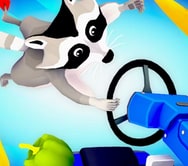
What happens when a store full of raccoon customers is worse at keeping things tidy than actual raccoons? That’s the setup Raccoon Retail runs with, and it doesn’t waste time explaining itself. You’re handed a cleaning machine, dropped into a supermarket aisle, and told to keep the mess under control before the whole place turns into a dumpster with a roof.
| Genre |
Casual simulation / management |
| Platform |
Browser (desktop and mobile) |
| Role |
Raccoon janitor |
| Core loop |
Clean spills, dump trash, upgrade the store |
| Community rating |
4.7/5 from over 79,000 votes |
Driving the Cleaning Machine in Raccoon Retail
The mechanic at the center of Raccoon Retail is almost aggressively simple: steer your cleaning machine through the aisles, drive over anything the customers have knocked loose, and haul it to the dumpster in the corner to cash it in. The machine automatically vacuums up whatever it touches, so the actual skill is in routing yourself efficiently rather than in any kind of precision aiming. That simplicity is exactly why the game reads as a quick, replayable session rather than a project.
Beginners usually make one avoidable mistake early on: driving straight through a customer or slamming into a display case. Both cost you money instead of earning it, which stings more than it should given how forgiving the rest of the game is. Once you internalize the aisle layout, though, dodging customers becomes second nature and the run turns into pure route optimization.
Difficulty in Raccoon Retail doesn’t come from enemies or timers so much as from the store itself getting messier as customers multiply. Liquids like spilled detergent or wine will seep under the shelving into a neighboring aisle if you’re not fast enough, and by the time you’ve upgraded into a bigger store, you’re covering more ground while the mess-generation rate hasn’t slowed down at all.
Upgrades and Decorating Your Raccoon Shop
Every trip to the dumpster converts collected trash into money, and that money funds two very different upgrade paths. One is purely functional — speed, capacity, and cleanup radius for your machine. The other is decoration, letting you fill out the store with posters and furnishings that do nothing for your cleaning stats but change how the place feels to drive through.
A decent chunk of the player base treats decorating as a distraction from optimizing their run, while another chunk considers it the actual point of playing Raccoon Retail long-term — that split shows up constantly in player discussions and neither side is really wrong, since the game supports both approaches equally well.
By the time you’ve unlocked a few tiers of upgrades, the camera perspective and your machine’s handling will occasionally shift on you, which is a deliberate difficulty spike rather than a bug. It’s a small thing, but it’s the moment where players who’d been coasting on muscle memory usually mess up a run for the first time.
- Do items behave differently across the store? Yes — some items, like loose crabs, actively move around the floor instead of sitting still once dropped, which forces you to chase them down rather than just sweeping through in a straight line.
- What’s the fastest way to earn money early on? Prioritize capacity upgrades before speed ones, since a bigger tank means fewer trips back to the dumpster per aisle you clear during a single run.
- Does running into customers actually cost you progress? It costs money directly, and crashing into displays at speed does too, so cautious driving around crowded stretches pays off more than aggressive shortcutting.
Raccoon Retail never pretends to be more than a five-minute loop of chasing spills and cashing them in, and that honesty is what keeps players coming back to it between longer sessions of other games. Whether you’re the type chasing a spotless store or the type filling every wall with posters, the dumpster in the corner is where the whole thing keeps circling back to.