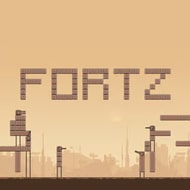
In Fortz you start the match standing next to your own cannon, a stack of bricks nearby, and a fort that’s currently just an idea. Nothing about the setup tells you how quickly that changes once air strikes and robots start getting called in from across the map.
Controlling Your Cannon in Fortz
Fortz is built around close, physical control of your weapons — you have to stand near a cannon to actually operate it, which means positioning matters just as much as aim. Player one uses W and S to aim and D to shoot, while player two uses the up and down arrow keys to aim and the left arrow to fire. Both players place bricks using S or the down arrow respectively, which is how you actually build a fort rather than just standing in open ground taking hits. This tether between player position and weapon control is what makes Fortz feel more physical than a typical artillery game — you can’t just camp behind a wall and fire indefinitely, since stepping away from the cannon to grab a falling crate leaves it unmanned.
New players tend to underestimate how much the brick-placement system matters early on. It’s tempting to focus entirely on landing shots against the opposing fort, but a player who neglects their own defenses will find their fort crumbling well before they’ve done equivalent damage in return. The players who consistently win tend to split their attention between offense and reinforcing their own structure rather than treating construction as an afterthought, laying bricks in short bursts between shots instead of waiting for a lull that may never come.
Difficulty in Fortz isn’t scripted the way it is in a single-player campaign — it comes entirely from your opponent, whether that’s a friend on the same keyboard or the AI. Matches against AI ramp up as the fort takes damage and the AI starts prioritizing offensive pushes, while matches against another player escalate based purely on how aggressively your opponent plays. Players who enjoy fast, high-pressure matches tend to seek out human opponents specifically because the AI’s escalation follows a predictable curve, while players newer to the game often start against the AI to learn cannon timing before risking a match where a real opponent punishes every hesitation.
Air Strikes, Robots, and Dogs
Beyond the base cannon-and-brick loop, Fortz layers in three special attacks that shift the pace of a match. Picking up an A box sets up an air strike, D triggers a dog attack, and R calls in a robot. These crates fall periodically during a match, and grabbing one before your opponent does is often the difference between a stalled-out standoff and a decisive push through their fort. Each attack behaves differently enough that recognizing which crate just dropped matters — a robot tends to grind through brick defenses over time, while an air strike hits hard and fast but leaves you exposed while you’re away from your cannon retrieving it.
Community discussion around Fortz tends to split on how these special attacks affect balance — some players think the robot and air strike options let a losing player claw back a match too easily, turning skillful brick defense into a coin flip once crates start falling, while others see it as exactly the kind of chaos that keeps repeated matches from feeling identical. That’s a genuinely divisive point in how the community talks about the game, and it’s worth acknowledging rather than glossing over, since it shapes whether a given player treats Fortz as a precision artillery duel or a chaotic party game.
By the time both forts have taken a few rounds of damage, matches in Fortz usually come down to whichever side manages their special attack crates better rather than raw aiming accuracy, which is worth knowing going in if you’re expecting a purely precision-based artillery game. Once a dog attack lands directly on an undefended brick section, the momentum of a match can flip entirely within a few seconds, which is exactly the kind of swing that keeps rematches feeling worth playing even after a lopsided loss.
Can you play Fortz alone against the computer?
Yes — Fortz supports solo play against an AI opponent in addition to local two-player matches, which makes it playable even without a second person on hand, and it’s a common way for new players to get comfortable with cannon aiming before jumping into a match against a friend.
What do the A, D, and R crates actually do in Fortz?
Picking up an A crate calls in an air strike on your opponent’s fort, a D crate triggers a dog attack, and an R crate summons a robot — all three are timed special attacks that fall periodically during a match and reward whichever player claims them first, often becoming the deciding factor in an otherwise even fight.
Is there a way to design custom levels in Fortz?
Fortz includes a level editor that lets players build their own battlegrounds beyond the premade stages, which adds a layer of replayability for players who’ve cleared the default level set and want more control over fort layout and crate placement.
Whether you’re locked in a two-player match on the same keyboard or working through the level editor to design your own battlefield, Fortz keeps coming back to that same tension between building your fort and tearing down someone else’s — and the dog attack crate is usually the thing that decides who blinks first.