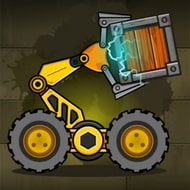
One detail trips up almost everyone in their first ten minutes with Boxrob: moving a box too fast while carrying it can make it slip right off the forklift’s arm, turning a simple delivery into a scramble to recover it before it rolls into a hazard.
| Genre |
Physics-based puzzle platformer |
| Core tool |
Telescopic forklift arm |
| Objective |
Deliver all boxes to the truck or marked slots |
| Controls |
Move, extend/retract arm, grab and release |
The Telescopic Arm Is the Whole Puzzle in Boxrob
Everything in the game routes through one tool: a telescopic arm that extends, retracts, and grabs. It sounds simple written out, but the arm’s reach and the way it interacts with box weight and momentum is what turns each level into a genuine logic problem rather than a straightforward fetch task.
Players coming from pure Sokoban-style box-pushers tend to underestimate how much the grabbing mechanic changes things. Instead of just shoving boxes along the ground, a player has to think about vertical positioning too — stacking boxes to reach a ledge, or using one as a temporary bridge over a gap.
The delivery truck at the end of each level won’t accept a box dropped carelessly nearby; it has to land in the marked slot, which sounds obvious until a level’s layout makes the direct path to that slot the hardest part of the puzzle.
Order of Operations: What New Players Get Wrong
The single biggest beginner mistake is grabbing whichever box is closest without checking whether moving it first blocks access to another one later. Boxrob levels are frequently built so that the order you handle boxes in matters as much as whether you handle them correctly at all — move the wrong one first and a level that had a clean solution becomes a reset.
That’s exactly why the undo and restart options exist, and experienced players use them liberally rather than treating a reset as a failure. Planning a full route by scanning the level before touching a single box saves far more time than improvising halfway through.
How Boxrob Gets Harder as You Progress
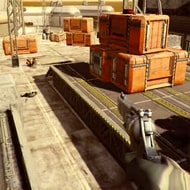
Early stages just ask a player to drive around and collect boxes in open space. That changes fast. Conveyor belts start moving boxes without player input, color-coded boxes need to go to matching destinations instead of any open slot, and later levels introduce multiple robots that have to be switched between and coordinated to solve a single puzzle.
By the time conveyor belts show up, a level stops being about finding boxes and starts being about timing — grabbing a box off a moving belt before it drifts into a hazard zone takes a different kind of attention than the static early puzzles required.
Stacking and Bridging Techniques in Boxrob
Advanced play in Boxrob leans heavily on using boxes as makeshift platforms or bridges rather than treating them purely as delivery cargo. A box that’s technically meant for the truck often has a second job first — filling a gap so the forklift can reach a ledge it otherwise couldn’t.
- Scan the full level layout before grabbing anything
- Identify which boxes are needed as platforms versus final deliveries
- Move platform boxes into position first, since they usually block later access
- Carry cargo boxes slowly to avoid slipping them off the arm mid-move
Multiple Robots and Color-Coded Deliveries
Once multi-robot levels appear, the puzzle shifts from single-path planning to managing two agents that can block or help each other depending on order. Some players find this the most satisfying stretch of the game; others find the added switching mechanic clutters what was a clean, minimalist puzzle formula, and that split shows up regularly in player discussions.
Why Boxrob’s Physics Can Feel Finicky
The physics system that makes stacking satisfying also causes the game’s most common frustration — boxes shifting or toppling when the forklift moves too aggressively while carrying one. It’s not a bug exactly, more a deliberate constraint that rewards careful, slower movement, though plenty of players describe it as the game’s roughest edge.
What’s the fastest way to figure out a level’s solution in Boxrob?
Study the layout first — where the truck’s marked slots are, which boxes block others, and whether any conveyor belts or color-coded destinations are involved — before touching a single box, since blind trial and error usually wastes more moves than a short planning pause.
Why does my box keep falling off the forklift?
Moving too quickly while carrying a box destabilizes it under the physics system. Slowing down, especially on uneven terrain or higher platforms, keeps the box secured to the telescopic arm until it’s ready to be placed.
Can you undo a mistake without restarting the whole level?
Yes — the undo function reverses the last move, which is faster than a full restart when a single misplaced box, not the entire plan, caused the problem.
Whether it’s a two-box early stage or a later level juggling conveyor belts, color-coded destinations, and a second robot to switch into, Boxrob keeps circling back to the same core lesson: the telescopic arm rewards patience over speed, every single time.