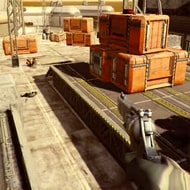
You have one weapon, a hundred bullets, and an industrial corridor that keeps producing more aliens than you can comfortably track. Aliens Nest doesn’t build up to that pressure — it starts there and just keeps applying it, which is exactly why runs tend to end faster than players expect the first few times through.
| Genre |
Survival shooter |
| Platform |
Browser (desktop) |
| Starting loadout |
One weapon, 100 bullets |
| Core loop |
Move, aim, shoot, scavenge ammo |
Movement and Ammo Management in Aliens Nest
The controls are deliberately minimal: WASD to move through the industrial environment, mouse to aim and shoot, E to pick up items, R to reload. That’s the entire toolkit, and the game leans on that simplicity to keep the pace fast. What separates a long run from a short one isn’t reflexes so much as positioning — standing still to line up a clean shot is the single fastest way to get swarmed, since the moment you stop moving, every alien in range treats you as an easy target instead of a moving one.
Beginners consistently make the same error: they treat the starting hundred bullets as a generous buffer and burn through them without checking corners for pickups. Munition and additional weapons are scattered through the industrial environment, and the game expects you to route past them rather than commit fully to the first open lane you see. Running dry mid-fight in Aliens Nest is close to a death sentence, since reloading takes a beat you often don’t have once aliens are already closing, and the animation locks you in place at exactly the moment you need to be circling instead.
Difficulty scales almost entirely through proximity. Aliens that are near you close the distance quickly, and the game punishes players who let a cluster get within melee range rather than thinning them out at a distance. Early in a run this is forgiving; by the time you’re several waves deep, a single missed retreat can end things. Players who favor a more aggressive, close-quarters style will often bait a smaller group into a corridor specifically to funnel them into a line rather than let them approach from multiple directions at once — a technique the community sometimes calls kiting into a chokepoint, and it’s one of the few genuinely strategic decisions available in an otherwise reflex-driven loop.
Reading the Industrial Environment
The setting in Aliens Nest isn’t just a backdrop — tight corridors funnel enemies into predictable lanes, while more open sections give you room to circle and create distance. Players who favor aggressive, close-range playstyles tend to gravitate toward the tighter corridors where they can control chokepoints, while players who prefer kiting and distance management look for the open rooms specifically to keep multiple angles of retreat available. A third type of player, the ones chasing a pure high-score run rather than survival time, tends to memorize which rooms spawn the densest alien clusters early and routes toward them deliberately to rack up kills while ammo is still plentiful.
One thing the community tends to agree on, even the players who enjoy Aliens Nest a lot, is that the lack of any real narrative or level variety limits how long a single session holds interest — it’s built for short, replayable rounds rather than a sustained campaign, and treating it as anything else sets up disappointment. That’s a fair criticism rather than a dismissal: the game was never designed around progression systems or story beats, and judging it against titles that offer those things misses what it’s actually trying to be.
Once you’ve cleared a handful of runs, the industrial environment starts to feel less like a maze and more like a set of tools — a specific junction near the starting point, for instance, becomes a reliable fallback spot once you know aliens funnel through it one or two at a time rather than as a full group. Recognizing those patterns is really the only form of long-term skill growth Aliens Nest offers, since the weapon and movement options never expand beyond what you start with.
- How many bullets do you start with in Aliens Nest? You begin each run with 100 bullets for your starting weapon, with additional munition and alternate weapons found scattered through the level via the E pickup prompt, so managing that initial supply carefully in the first minute or two sets up everything that follows.
- Can you avoid getting swarmed in Aliens Nest? Constant movement is the main defense — standing still to aim gives nearby aliens a clean approach, so circling through open areas while shooting is far safer than holding a fixed position, especially once three or more aliens are converging on your location at once.
- Is there an ending or objective beyond survival? No formal ending exists; the goal is a high score measured by how many aliens you defeat and how long you last before being overwhelmed, which is why most discussion around the game centers on personal bests rather than completion.
Aliens Nest doesn’t ask for much beyond quick decision-making and a willingness to keep moving, and that’s precisely the appeal — every run in the industrial corridor is a fresh attempt to beat your last score before the aliens close in for good.